My favourite post-apocalyptic vegetable

It's been a busy month so I thought I would re-post my October newsletter for those who may not have yet subscribed. If you would like to stay abreast of what is happening in the world of Mordecai Crow as well as get a few sneak peaks of work in progress, click on the subscribe button at the bottom of this page.


I’ve decided butternut squash is now my post-apocalyptic vegetable of choice. 

I subscribe to a few comic creator newsletters and I'm in awe of their busy schedules, new releases, and appearances at comic conventions around the globe. But I don’t envy them. My fall is a bit simpler. My second book is now off to be prepared for printing and I am back in my happy space, having just pencilled and inked page 100 of the third Mordecai Crow volume. Which is why all my news this month is more about foraging and less about my book!

Working on Mordecai Crow has got me to thinking quite a bit about how one might survive in a post-apocalyptic world. So back to the butternut squash. We harvested almost 20 of these big beautiful brutes this year and after growing them last year discovered that they keep fine for most of the winter. That could be a nuclear winter, a "Golly, climate change caused the Gulf Stream to just stop!" sort of winter, or what have you. A long time. So now we are self-sufficient in both garlic and squash when the apocalypse comes. It’s a start.

The fact that we are half way through October and have not yet had a frost is one of the few upsides to climate change, meaning our garden lives to a healthy old age and now dies a natural death. Thirty years ago, when we first moved to the country, our garden would regularly be struck down mid-September by a killer frost, with us scrambling to save what we could and bringing bushels of green tomatoes indoors to ripen off the vine. Not anymore. It probably means nasty diseases, insects and other unforeseen horrors will also thrive while species that can’t adapt will perish. But at least our garden will do well - barring floods, droughts, fires…

October is also my favourite foraging month. Elm oyster mushrooms, one of my favourite mushrooms to forage as they are so easy to identify, come out in the first couple of weeks in October. My partner is not fond of them, so I find people to lure into foraging with me because it's a fun as an Easter egg hunt!
Here's a video that will help you identify them:
https://youtu.be/-G4osnMMOPc?si=wEF8H05a0kluNOwW

It’s also when the silver berries ripen, an introduced species that now grows wild - there are many related species that grow throughout the world, but they are not well known here. I know a sunny hillside in the woods where we picked two kilos of them in a short amount of time in early October and there were still bushels left for the bears and chipmunks (which the Internet tells me are our major rivals). 
Also known as autumn olive (for its leaf, not the berry) you can read about it here: https://steemit.com/nature/@seedvault/foraging-in-ontario-autumn-olive

And this year my partner, on learning how good they are for you, began harvesting some of the black walnuts that surround our yard. They are surprisingly good, walnutty but a bit greener tasting and native to this area. But beware the dye in the husks which can turn your hands brown, even if you are wearing latex gloves, and be prepared to use a hammer to break through the shell! 
https://guffguelph.ca/2010/04/21/your-black-walnut-is-a-very-specialtree/

https://foragerchef.com/category/nuts-seeds-starches/black-walnuts/

Personally I would miss not being able to buy most of my groceries at the store, but I’m constantly surprised how novel the idea of foraging our food from the wild seems to be to so many people when every other wild species on the planet survives by doing exactly that. Of course, there are too many of us (a hunter gatherer group needs seven to 500 square miles to survive) but by every measure imaginable, hunter gathers were healthier, happier and longer-lived than their agrarian counterparts. Than us. So go forage…

Keeping up with Comics

Speaking of newsletters that I follow, I thought I would share a couple of my favourites. These aren't creator newsletters, but rather a great way to stay up to date with what is happening in the world of comics.

The Comics Journal

I really like this one. More my speed, not so much superheroes but rather indie comics and stuff that will never be franchised into a summer blockbuster. Here is their link with a newsletter subscription box part way down. https://www.tcj.com/

True North Country Comics Newsletter

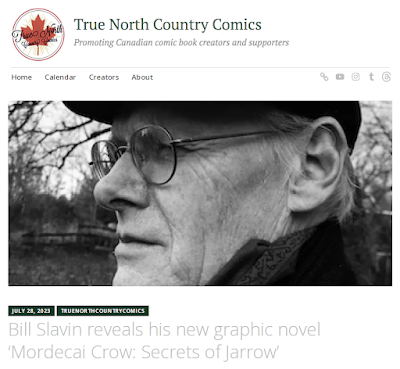
John Swiminer, the driving force behind True North, not only produces a regular podcast with comic creators but also does a great round up of Canadian comic news in his regular newsletter, which can be subscribed to here: https://tnc.news/subscribe/

In the land of the blind the one-eyed man is king


 It was only after my serious eye issues started to spin out of control in 2019 did I make the connection that three of my four principal characters in Secrets of Jarrow were also visually impaired! In the summer pre-Covid an undiagnosed retinal detachment lead to further complications months later that have now spun out over the following four years into no less than nine eye operations, not counting a handful of laser surgery episodes as well. For the past year and a half I have been viewing the world through an eyeball full of cloudy silicone oil with a retina that resembles 100 miles of bad road and makes the world look as if it is reflected in a fun house mirror. Which is no fun at all.

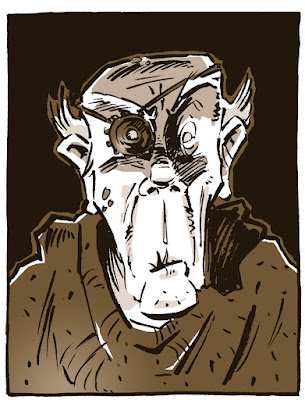
But when I was drawing up Secrets of Jarrow and developing the characters for the first of the Mordecai Crow books all that lay far in my future. It was just coincidence (or maybe premonition?) that gave Podd his massive techno goggles, Veritas her eye patch and Teknos his steam punk jewellers’ loop. So why all the character eye problems?

I think there are a lot of answers to that. The first is simply visual - no pun intended. I like drawing characters with eye paraphernalia. Maybe it is partly because I have worn glasses myself since I went all myopic as an adolescent, but I find eyewear helps give the characters their unique personality. Podd’s goggles mark him as a myopic computer nerd, Veritas’ eye patch as being a bit tough and bad ass and Teknos’ loop and cataract eye as a quirky eccentric. 

I was thinking that also, in a future world, something as specific as eye care is going to be pretty unlikely. Cataracts likely won’t be treated, damaged eyes won’t be fixed and although I could well imagine that a plethora of old eyeglasses might be filling the dumps, it would be a matter of sifting through them all until you find a prescription that comes close to suiting your needs.

These days, as I walk around all squinty and blind in one eye, hopefully short term but finding out that I face yet another eye operation tomorrow, perhaps all my one-eyed and visually impaired characters seem a little bit too close to the mark. But I’m also thinking, maybe I’m just becoming Teknos - the querulous old bastard already got most of the best lines in the book and his cynical views of humankind’s future are paralleling my own more and more as I slowly morph into my own comic book character. In the land of the blind, the one-eyed man is king!

Now just to Google “steampunk jeweller’s loop”. Gotta be one out there somewhere… 

Cli-Fi - who knew?

Cli-fi. Now there is a term I hadn't encountered before. It turns out Mordecai Crow is at the relative cutting edge of a new sub-genre of science fiction, cli-fi or climate fiction. I first encountered the term in a really nice article on Secrets of Jarrow in Prairie Books NOW by David Fuller, which I will link to below.

Originally coined in the early 2010's, it has been retroactively applied to works such as Margaret Atwood's Oryx and Crake (2003) of her MaddAdam trilogy (let's face it, we've known about this for a while, folks!) Most simply put, it is fiction literature that features a changed or changing climate. I get a little bit antsy having my book slotted into that genre, as there is an implied polemic quality that I never intended for my book. But as you can read here, story-telling can be a powerful tool for connecting people with possible futures and moving them from apathy to action. So I'm good with that.

My motivation for placing Mordecai Crow in a future world ravaged by climate change began, in all honesty, as a way for me to place him into a decaying world, a sort of early medieval-like setting, a period that I am fascinated by and, more importantly, would allow me to to draw things I love. Stuff like old stone, crumbling ruins, decay, rooms lit by torch and candle light. It of course also gave me a chance to explore themes around climate change as Crow unearths bits and pieces about the collapse of the world, and I am not averse to throwing in a bit of climate change soap-boxing, if for no other reason than to make my activist big brother a bit happier. But at the end of the day, like the technology melt-down and GMO-induced crop crisis that are also parts of Mordecai's future world, they are mostly devices to propel the plot forward and create an interesting and challenging world that our hero needs to negotiate.

Crow and Podd ruminate about a long lost world in Book 2, due out next spring. I would miss my pond of peepers outside!

I can't pretend that Mordecai's world is in anyway an accurate portrayal of a world ravaged by climate change. Things like summer snow storms and flooded cities are mostly just new ways of changing things up in the narrative, but I have loved the process of imagining what that world may look like. Mordecai's world is probably a gentler version of the real potential for disaster (I like drawing trees!) but with so many balls in the air - things like a possible slowing or stopping of the Gulf Stream that could plunge Europe into another ice age even while the rest of the world heats up, or a technological meltdown coupled with other disasters that could precipitously de-populate the world en masse (having the happy side effect of actually allowing us to reach our emissions targets!) - I don't feel the need to be accurate.

However, as we go through this summer of almost continuous bad news on the climate front, amplified no doubt by media's need to scare us shit silly but never-the-less of epic proportions, I am happy to think that this book might have the potential to shift the needle ever so slightly in our response to this global crisis. And as the bad and sometimes whacky news pours in (like a massive mid-summer hail storm in Germany the other day that required snow removal equipment to be brought out to clear the streets) I'm thinking that truth surely is stranger than fiction, and maybe a July snowstorm wasn't so far-fetched after all.

And some newsy bits...

Prairie Books Now features Secrets of Jarrow

David Fuller's interview with me that led to this article was possibly one of the most interesting interviews I have had. It is also where I first encountered the term cli-fi!


And I got to do another podcast!

I have discovered that I really like the format of podcasts, where there are no cameras and I am simply a disembodied voice wafting over the digital airwaves. I had a nice discussion with John Swinimer over at True North Country Comics Podcasts. John is doing a great job of bringing Canadian comic talent to people's attention and we had a very interesting chat that you can listen to here:

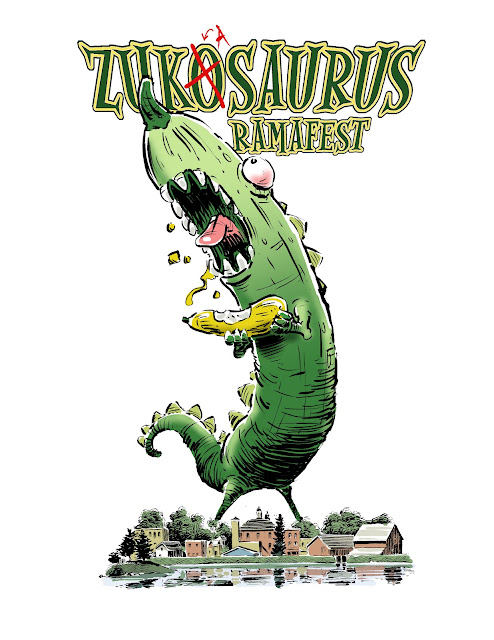
And finally, a shout out for the upcoming Millbrook Zucchini Festival, which will be happening on Sunday, September 10, 12:30 to 4. And why am I excited about this? Because it's only the best vegetable festival in Canada. (And I did the poster art, of course!)

And sign up for my newsletter, A Murder of Crows!

For the latest in all things Mordecai Crow, including some sneak looks at work in progress, sign up using the form below!

Imagining Crow

 I was leafing through some of my old sketch books the other day and found some of my early sketches and notes for Secrets of Jarrow. These aren't the earliest but rather some I created when I returned to working on the book a few years after I had first played around with the idea.

I wanted to rework my Mordecai Crow character and ended up with these, which I quite liked. At this point I was thinking he might have a crow companion, but abandoned that idea. You will notice that in the book version he acquired a coat and scarf, as he had in my first imaginings a decade ago, but stylistically I was looking for something a bit more simplified. I wanted to render the book with a brush pen rather than pen and ink, as I had on the first pass which you can see in this post here: http://www.billslavin.com/2023/04/from-archives.html

Here are a few of those second round sketches:

The first sketch is very stylized and stiff I didn't like it at all. But the second, where I abandoned my pencil and went straight to the brush pen captured more of the feel I wanted.


Continuing with the second rendering, I sketched out another page of Crow figures. These are obviously a bit looser and more cartoony than the book version but I liked their energy and consulted them constantly as I went forward with finals.

As almost the entire first book takes place in Jarrow Firewall, I needed to imagine that as well. I draw heavily on things I have seen on our extensive travels but in this case I was looking for something more exotic. I stumbled on some images of Armenian monasteries, and found those to be the sort of thing I was looking for. Armenia is the oldest Christian country in the world (sine 301 A.D.) and as such has had some time to figure out how to build some stunning monasteries! Jarrow ended up being an amalgam of a couple of the structures you can find at this sight. 

https://sacredwanderings.com/best-monasteries-in-armenia/

(These I would love to see in person!  Some day, maybe...)

But I knew that Jarrow, although originally medieval, would also need some modernist touches for reasons which will be revealed in the story. I researched some images of integrating modern architecture with historic buildings, and implemented some of that. I also scattered about some re-roofed buildings, some thatched, others tiled, thinking that buildings have that had fallen into disrepair might have been made inhabitable again. I drew a quick sketch of how that might look as a point of departure.

As you can see in my notes the portico of the original monastery is in the foreground left, a ruin with modern architecture (now itself in ruins) is sandwiched in the middle, and a later 16th century dormitory with a modern copula is on the right. On the front of that building has been tacked on a stone construction, post Fall, with a thatched roof, in essence reverting to a more primitive form of construction. The tall tower I imagined as being built later than the dormitory, maybe 1800's, as a means to transport goods by elevator from floor to floor of the dormitory (possibly having been converted to workrooms) but also heightened and used as a watchtower.

Finally I realized I would need a ground plan to keep everything in order as the story progressed, so I sketched out that in my book as well.

The gestural sketches of Crow along with the ground plan and concept sketch of Jarrow stayed attached to my drawing board throughout the final art stage, keeping me firmly on track in the making of this book. 


And some newsy bits...

Signing at Chapters in Peterborough

I had the pleasure of meeting a few new faces and sharing Secrets of Jarrow along with showing off some sketches and finished art at the Chapters in Peterborough last weekend. Thanks to everyone who showed up - it was a great afternoon!

A really nice interview


While at my book signing at the Peterborough Chapters I had the pleasure of talking with Brendan Burke from the Peterborough Examiner about Secrets of Jarrow and my adventures in comic book making in general.
 Brendan wrote a great piece - thanks, Brendan! Here is a link to the article...

And sign up for my newsletter, A Murder of Crows!

For the latest in all things Mordecai Crow, including some sneak looks at work in progress, sign up using the form below!

Thumbnails to finals - the story continues

After my brief segue last month into gushing over one of my favourite graphic novels, Jeff Lemire's Essex County, I thought I would pick up where I left off previously. So I'm back to talking about about how Secrets of Jarrow came together. 

I spent a pretty idyllic summer a few years back sitting on my porch thumbnailing through the story in my sketchbook. I don't know if most comic book artists go through a thumbnail stage (see April's post) but I have always loved this part of book making. Unencumbered by the need to get everything right, it allows me to see the page in its entirety, think about points of view, darks and lights, close ups or distant shots, balloon placement and just generally how the story is best told graphically. Sometimes I will decide to spend an entire page or two with no words at all, just imagery to carry the narrative forward. Many of my important decisions are being made at this stage, as my written script is very minimalist with little or no description of action or panel breakdown. Minimal script writing is a luxury I can allow myself as I am writing my own text and don't have to communicate what is in my head visually to the artist, unlike many comic book writers.


So as I have said, my path forward is mostly determined at this stage and during the time spent creating the finals (a couple of years minimum) I reference these sketches closely and constantly. If I don't then it is easy to get bogged down in the details of the final art and lose the big picture. Often, in a gestural way, I have captured exactly the pose or expression I want or the scaling of art that I need in any given panel, and if I stray from this too far the final art can feel a bit flat.

Recently I have gone completely digital with my work (other than the thumbnails, which I still do in my sketchbook) and as a result have taken this one step further, scanning in the thumbnail as a first rough draft of the page that I can layer at the bottom of my document. I then work directly from that for my first pass - but more on my digital transformation later, Secrets of Jarrow was mostly done analogue!

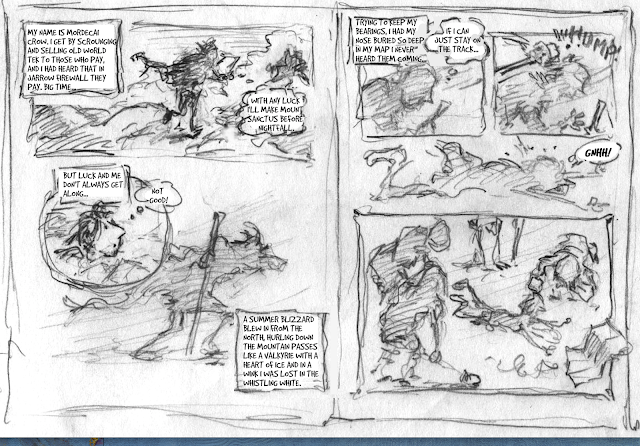
Here in this thumbnail from the book I'm currently working on I managed to capture exactly the feel I wanted...


which I hopefully was able to replicate in the final art.


I will post a couple of examples here, showing the thumbnail and my final inked page from Secrets of Jarrow, just to illustrate how closely those quick sketches resemble the finals. Ideally I would show the final pencils rather than the inked page, but as I inked directly on the pencils, that intermediary stage no longer exists for this book!


I always liked this sequence, which happens early in the story. Hopefully you can decipher my thumbnails (they really are just for me to understand!) but I think you can see how the page structure and Crow's body language translates to the final line art. I adopt a more cartoony style for my thumbs as a short hand to getting the action right.
My only real change in the final was adding the Crack! in panel three, which sets up the sequence on the book's following page.

Again, you can see how the layout for this page tracks pretty closely to the inked final below. Interestingly enough, in this sequence I have Podd with Crow (upper right). This is p.26 in my thumbnail layout, but I did a major re-write after finishing the thumbs, inserting ten more pages before this one, so that the inked version below is numbered p. 36 in my file.


Speech balloons have moved around a bit and Podd is no longer in the scene, but the shape of the page remains the same!


And some newsy bits...

My First Podcast!

Wayne Hall at  Wayne's Comics (Major Spoilers) contacted me last week to talk about Secrets of Jarrow and comic-making in general. I spent a really enjoyable hour with Wayne and we covered a lot of ground! If you would like to hear the podcast it can be found here at this link:

And my first review!

I was really pleased to open the Toronto Star today and find a review of Secrets of Jarrow in Mike Donachie's graphic novel column. The review of Secrets along with three other great new Canadian comic releases can be found online at this link:

Revisiting Essex County


 Okay, I promised last post to pick up where I left off, talking about process, but I really want to go in another direction this month and talk about this book.

I had shared on my Mordecai Crow Facebook page that I was watching and very much enjoying the series adaptation of Jeff Lemire's Essex County (you can watch it here). This was an adaptation that felt very true to the original book, and small wonder as Lemire was closely involved in both the writing and production of the series. (I'm only guessing, but wonder if this was in reaction to seeing what happened with Warner Brothers adaptation of Sweet Tooth, which I have also watched and enjoyed - to a point - but that has not felt much like Lemire's work!)

Seeing the series inspired me to get out my own copy of The Complete Essex County (2009, Top Shelf) that I had last read when it first came out. Around that time (2010) it had been chosen as a Canada Reads selection and I remember hearing some of that debate on the radio. One person was generally trashing it as a selection, saying that they couldn't accept the title "novel" attached to something they could read in an hour. 

First of all, clearly this person did not get it and if you are "reading" Essex County in an hour or two then you are not reading it at all. It is like saying you watched a film by fast forwarding though it. I was blown away all over again when I re-read Essex County, swept up in the quiet, deep and at times painful story that Lemire magically produces with his pen and brush (guessing there, but it feels like pen and brush work). This book is a collection of stories, all taking place in the flat farm country of Essex County in southwestern Ontario where I am assuming Lemire grew up. The stories interconnect somewhat and that inter-connection was woven into a more cohesive version for the screen play, using the two main stories Tales from the Farm and Ghost Stories as the framework on which the series is built. Some of the collected stories don't even make an appearance in the screen version, but many do and those are effectively worked into a succinct narrative.

But what I really wanted to talk about is Lemire's artwork. It's probably impolitic of me even to mention this, but I'm not really a huge comic book fan. More on this later, but suffice to say I read a lot of comics as a kid, but I never had a superhero collection. And I have read quite a few comics and graphic novels since, and enjoyed some, but mostly it is the artwork that draws me to them, with Euro comics being my favourites. Most of my reading is traditional novels. 

However, to my mind, Lemire's work is transcendent, showing the true possibilities of the medium and how it can grab you on a very deep and emotional level. I have read a few other graphic novels that have done the same but very few.  I love how he can draw a page and you will just sit and stare at it and think, wow, how did he do that? Like so much great cartoon work, his line looks deceptively simple and even child-like at times, but I know it is something I could never accomplish. It is more like music in that it bypasses the rational mind completely and engages on a deeper, more emotional level. He has an almost cavalier disregard for perspective and his cast shadows sometimes make no sense at all technically. Children's faces at times appear as those of an 80 year old. But somehow it all works and as you look at it more closely you realize that Lemire doesn't really care if things are wonky - he draws what needs to be drawn to communicate what he needs to say. The pain and suffering etched into the faces is palpable, the darks and lights create a mood that takes you deep into the story and series of pages pass by without a word of dialogue, but speaking volumes.

I thought I would go out on a limb and share a coupe of images from the book here to show you what I am talking about. These were included in a posting by the defender of the book in Canada Reads 2010 (sorry, it is one of the twins Tegan and Sara and I don't know which!) and can be found here so I think I am safe in re-posting them. Interestingly enough, it is the exact same sequence I had in mind when I started this post.


Two images from Ghost Stories. This is an imagined sequence as Lou disappears into his memories. Lemire's use of darks and lights here, the brushwork in the underwater light, the tears streaming from his eyes as he descends into the water. How can you not be moved by this art??

There is so much more art I would love to share from this book, but my best recommendation is for you to go out and buy your own copy or borrow it from your local library and see for yourself why this book is a masterpiece. Re-read it if you haven't lately. Just please give the time due to each panel and let yourself soak it in on a deeper level. And experience the power that can reside in visual story-telling at its best.

Newsy bits

Now available in bookstores!

I almost forgot to add that Secrets of Jarrow is now available at bookstores and can be purchased online! And if you have enjoyed the book, please feel free to leave a rating and maybe even a review through the Goodreads link at the bottom of this page.

TCAF 2023

Signing Secrets of Jarrow at the Renegade booth at TCAF, with publisher Alexander Finbow.

In other book-related news, I attended the Toronto Comics Arts Festival at the end of April and had the pleasure of meeting face to face with Alexander Finbow, the publisher at Renegade Arts and Entertainment. Alexander lives in Canmore, Alberta, and up until now, we had only spoken though Zooms and e-mails (many, many e-mails!) Turns out he is as nice a person in person as he has been in all my dealings with him online.

The festival was terrific fun and I was excited to have the chance to share my book with so many indie comic book fans.

From the Archives...

 Back again...

So, picking up where I left off last month, I thought I would continue with the story of Mordecai Crow's development. Or more accurately, go back to some of the stuff I was talking about last time, but this time with pictures!

In my last post (you can see it here) I had incorrectly identified the first crack at Crow as being in 2015 (now corrected - fortunately no one had read it!) I have been digging through the archives and realize now I was off the mark by about 8 years - my earliest files are from 2007! I've been going around saying the book was a decade in the making but now realize 16 years have passed since I started thinking about this project. Yikes! Sadly, the over-arching context for the story, climate change, has only gotten worse.

In the last post I  also mentioned taking an early attempt at the art and thought I would share that here. These are from 2007, the story wasn't even written yet, but I was eager. I was mostly drawing in pen and ink at the time (had yet to discover the Pentel brush pen that changed my life!) and was colouring it digitally on the computer. Yes, in colour - the images will look familiar as they were the basis for my second go ten years later. My working title at the time was The Survivor, and it looked like this...

My first 2007 crack at Crow. You can see that I based the final version of the book on these images - if you click on the page above it will take you to a pdf of all of the first seven pages I completed.

I had also talked last post about the thumbnailing, most of which was done a decade later when I returned to the story. My process has changed on subsequent books (I am now well into Book 3), but you can see here that I wrote the text in the margins as I thumbnailed it!

Thumbnails for Book 1 with text written in margins.

I honestly can't remember if I was actually writing it as I went - judging by the fact that there seem to be few corrections, I think not and at this point was following a script, but I'm pretty sure the first few pages I thumbnailed back in 2007 were written straight into my sketchbook in conjunction with the art. Unfortunately I can't find those first 2007 thumbnail pages!

I eventually pulled together all my thumbnails into a single document and input digital text. As with all of the work I do, those thumbnails would serve as my road map for the next few years of creating the final art. More on that next time.

Thumbnail scanned in with text added digitally afterwards. Much neater! I'm almost positive these thumbnails were done after the first colour pages were done, but I dunno. It has been a long process.
Again, if you want to see what the entire book in thumnails, click on the thumbnail.

And some newsy bits


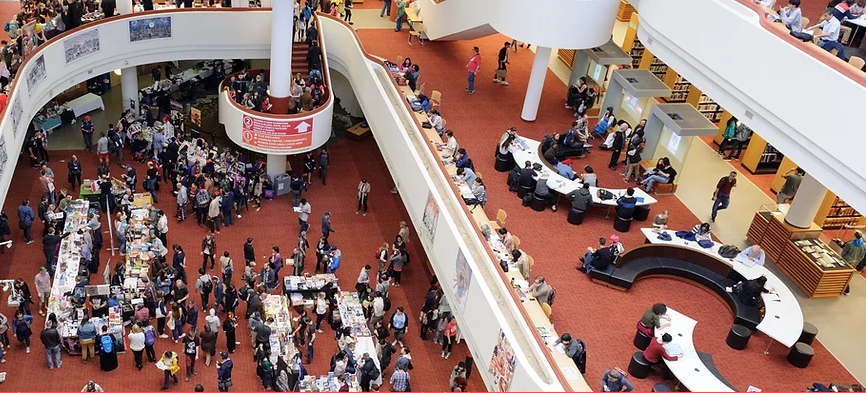
I will be at the Renegade table at the Toronto Comic Arts Festival this year, signing copies of Secrets Of Jarrow and just generally hanging out, from 2 p.m. onwards on Sunday April 30. If you are in the area drop by and visit - I would love to see you! This is a free event, held in the Toronto Reference Library just north of Bloor on Young. It's packed to the gunnels with indie comic book publishers from all over and with a full schedule of exciting workshops and panels.